
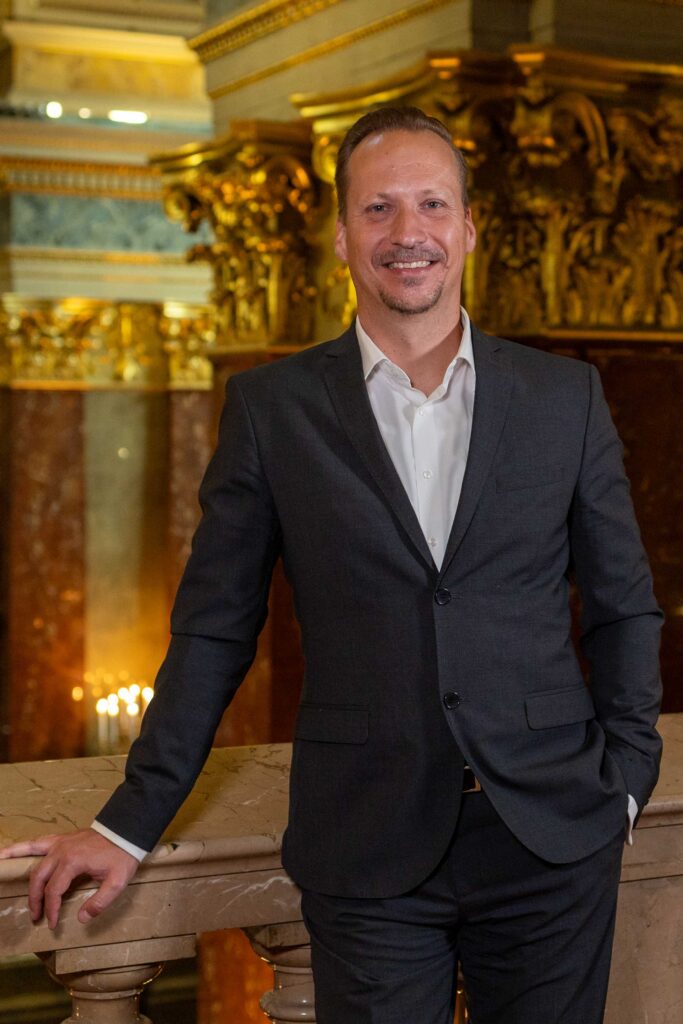
Gábor Szotyori Nagy
The organist at St Stephen’s Basilica, whose career is characterised by the preservation of Hungarian organ-playing traditions, the diversity of the concert scene and the unity of liturgical service.
Díjak és elismerések
Liszt Ferenc összes orgonára írott kompozíciója
Hangfelvétel a Szent István Bazilika megújult nagyorgonáján · 2026
César Franck összes orgonaműve
Teljes életműciklus · 2022
Koloss István emlékkoncert-sorozat
Kárpát-medencei koncertsorozat · 2020
Felix Mendelssohn-Bartholdy összes jegyzékszámmal ellátott orgonaműve
Teljes ciklus és hangfelvétel · 2020
Liszt Ferenc összes orgonaműve és átirrata
13 koncertből álló országos turné • 2011
beginnings
Gábor Szotyori Nagy is one of the most highly regarded organists of his generation and a prize-winner at numerous national and international competitions. He began his organ studies under the guidance of István Koloss, before continuing as a pupil of László Deák at the King Saint Stephen Secondary School of Music.
He obtained his degree in organ performance and teaching from the Faculty of Music at the University of Debrecen, and his diploma in piano teaching whilst studying at the Tibor Varga Institute of Music at Széchenyi István University. He has been an active participant in church music since childhood, and between 2010 and 2018 he served as organist at the Belvárosi Főplébánia Church.
He performs regularly in Hungary and abroad, appearing in seventy to eighty concerts a year as a soloist and chamber musician. His repertoire ranges from early Baroque to contemporary music, with a particular focus on Romantic organ literature and on researching and performing the works of his mentor, István Koloss. His artistic career has been marked by several major undertakings: he has performed the complete organ works of Franz Liszt, Felix Mendelssohn and César Franck, and most recently made a recording of all of Liszt’s organ compositions.
St. Stephen's Basilica
His connection with St Stephen’s Basilica began long before he took up his post as organist. His father, Gábor Szotyori Nagy Sr, was involved in the Basilica’s musical life for many years, so even as a small child he was able to experience the church’s unique atmosphere and the organ’s monumental sound. His earliest experiences with musical instruments are also linked to the Basilica: it was here, at the age of six or seven, that he first had the chance to try out the organ.
István Koloss played a decisive role in his choice of career; he became Koloss’s pupil, later his close colleague, and a dedicated custodian of his intellectual legacy. His personal connection to the Basilica has developed into a professional vocation over the years: today, as the church’s organist, he serves alongside colleagues whom he has regarded as role models since childhood.
He has a particularly close connection to the Basilica’s restored grand organ. He was able to make his first significant recordings on this very instrument, and following the restoration, the recording of all of Franz Liszt’s organ works was also carried out here. He is convinced that the restoration has produced a concert organ of European standard which worthily represents the tradition of Hungarian organ-building, whilst also offering the opportunity to perform the entire Romantic and modern organ repertoire authentically.
At the Stephanus International Organ Festival
For Gábor Szotyori Nagy, the Stephanus International Organ Festival represents both an artistic challenge and a personal mission. He regards it as an initiative that restores the renovated grand organ of St Stephen’s Basilica to its rightful place in the Hungarian and European concert scene.
His concert brings together the richness of the Romantic organ repertoire and Hungary’s musical heritage. Through his performance, he aims not only to showcase the instrument’s versatility, but also the continuity that links the Basilica’s past, present and future.